Full transcript of the episode (it gives away every surprise)
Question for the reader
Balls are thrown, one at a time, at a wall with two vertical slits in it. Behind it, a screen records where they hit. What pattern do you get?
- Two bands, facing the slits (correct answer)
- A single band, in the middle
- A series of alternating bands
If you answer “Two bands, facing the slits”:
Of course. And with light?
If you answer “A single band, in the middle”:
Two bands, facing the slits. Of course. But with light?
Question for the reader
Now light is sent through, grain by grain: a single photon at a time. What pattern do you get?
- Two bands
- A series of alternating bands (correct answer)
- Nothing: a single grain doesn’t get through
If you answer “Two bands”:
See for yourself.
If you answer “A series of alternating bands”:
That’s right. And it makes no sense.
Interactive experiment
One photon at a time
Send the photons one at a time, then by the thousands. Watch where they land.
The photons reach the screen one at a time, each at one precise point. As the hits add up, a series of light and dark fringes appears: the interference pattern of a wave that went through both slits.
Each grain of light goes through both slits at once.
And interferes with itself. Send the photons a minute apart if you like: the fringes still appear, dot by dot.
Light That Hesitates
A grain of light takes two paths at once, as long as nobody is looking.
Each photon lands at one precise point, like a particle. But the way the points are spread out draws fringes, as a wave would if it went through both slits at once and recombined behind them.
Before it is detected, the photon has no precise position: quantum physics describes it as a wave of possibilities, which takes both paths at once.
This isn’t a simulation. In 1989, in Japan, Akira Tonomura sent electrons, grains of matter, one at a time toward two slits. This is what his screen recorded.
Matter hesitates too. It has been observed with atoms, then with molecules of nearly two thousand atoms.
Question for the reader
And what if a detector is placed to find out which slit each photon goes through?
- The fringes stay
- The fringes disappear (correct answer)
If you answer “The fringes stay”:
They disappear. As soon as we know which way the photon goes, it behaves like a particle.
If you answer “The fringes disappear”:
Yes. As soon as we know which way the photon goes, it behaves like a particle.
It is enough for the information to exist somewhere, even if nobody reads it. This isn’t about consciousness: it is about interaction with the rest of the world.
Interactive experiment
The detector
Send photons, then turn on the detector and start again. Watch the fringes.
The same setup, with a detector that reports which slit each photon goes through. With the detector off, the fringes form; with it on, they disappear, and only a blob remains.
“It has in it the heart of quantum mechanics. In reality, it contains the only mystery.”
This is no laboratory curiosity. The transistors in your phone, lasers, MRI scanners, the atomic clocks on satellites: all of them rest on these laws. You are surrounded by machines that exploit a phenomenon nobody can really picture.
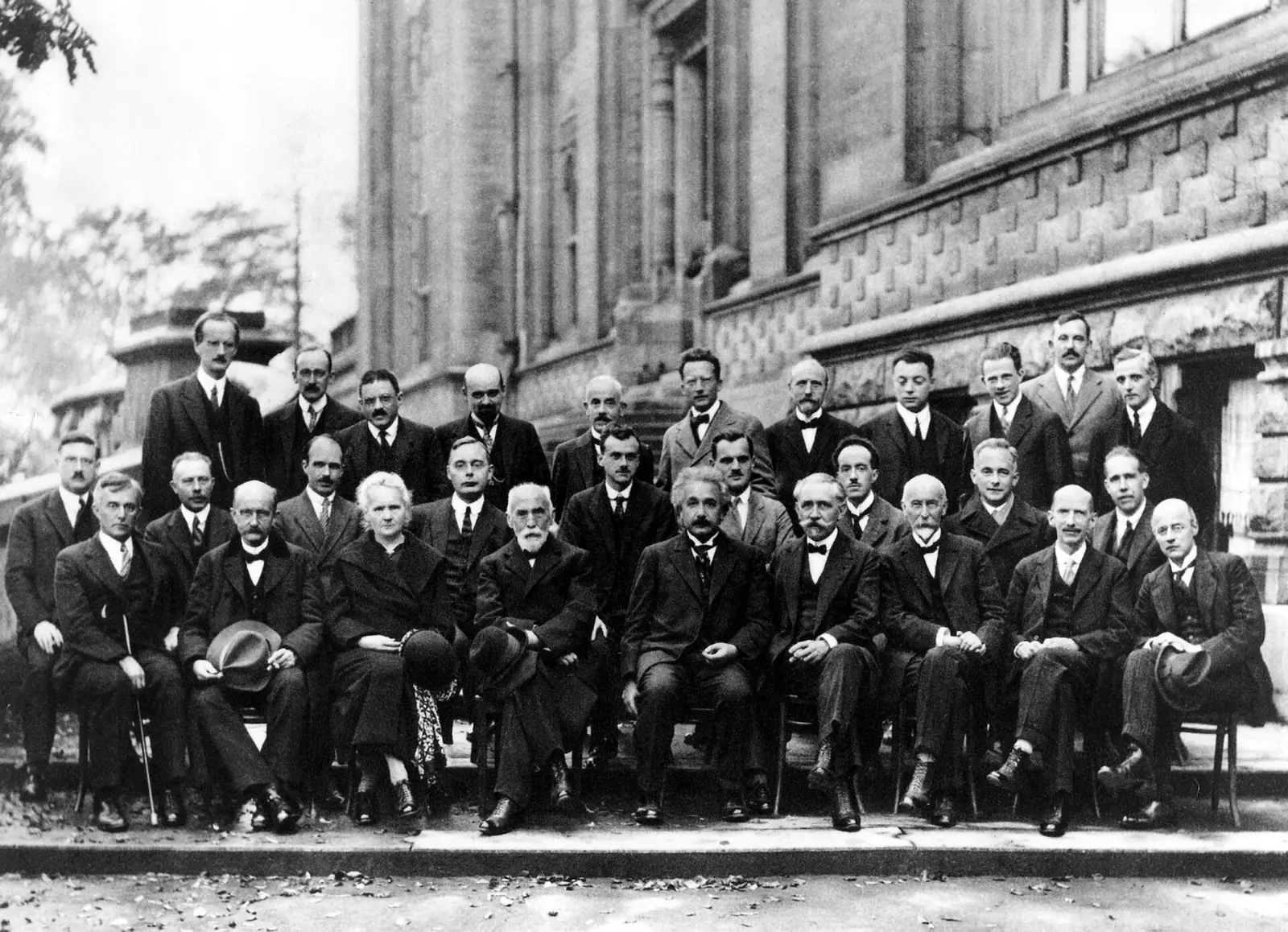
October 1927, Brussels, the fifth Solvay Conference. In this photo, twenty-nine physicists; seventeen of them had won or would win a Nobel Prize.
Benjamin Couprie · Public domainMarie Curie is the only woman in the photo. With Pierre Curie, she discovered polonium and radium, and she received two Nobel Prizes, in physics and then in chemistry.
There, Albert Einstein and Niels Bohr began a debate that lasted until their deaths. Einstein refused to accept that nature is fundamentally random: “God does not play dice.” Bohr is said to have replied: “Stop telling God what to do.”
Who was right? In 1982, at Orsay, near Paris, the French physicist Alain Aspect carried out a decisive experiment on pairs of “entangled” photons. Forty years later, it earned him the Nobel Prize, along with John Clauser and Anton Zeilinger.
The verdict: on this point, Einstein was wrong. Two entangled particles form a single system, however far apart they are.
Reality is not made of little marbles.
Superposition. As long as it is not measured, a quantum object is not in one state or the other: it is described by a combination of possibilities. Measurement forces it to “choose.”
If light hesitates between two paths, time, at least, flows at the same pace for everyone. A second is a second. Are you sure?
Sources
- Thomas Young, “Experiments and calculations relative to physical optics,” 1804; Akira Tonomura et al., “Demonstration of single-electron buildup of an interference pattern,” American Journal of Physics, 1989.
- Richard Feynman, The Feynman Lectures on Physics, vol. III, 1963.
- International Solvay Institutes, fifth Solvay Conference on Physics, 1927.
- Alain Aspect, Philippe Grangier and Gérard Roger, Physical Review Letters, 1982; Nobel Prize in Physics, 2022.