Full transcript of the episode (it gives away every surprise)
Interactive experiment
A photograph
Taken by a space probe, at the edge of the solar system. Somewhere in this image is Earth. Find it.
A black photograph crossed by rays of scattered light. In one of them, a tiny bluish dot, barely a pixel: Earth, seen by Voyager 1 from 3.7 billion miles away.
That’s here. That’s us.
Voyager 1 took this photo on February 14, 1990, from 3.7 billion miles away. Earth takes up less than a pixel. Every human being who has ever lived is in that speck of light.
The Pale Blue Dot
From 3.7 billion miles away, all of human history fits in a single pixel.
Carl Sagan had to fight to get this photo taken: turning the cameras toward the Sun risked damaging them, and the image had no scientific value. It became one of the most famous pictures in history.
“Look again at that dot. That’s here. That’s home. That’s us.”
Interactive experiment
The sizes of the universe
From atoms to galaxies, travel through the sizes of the universe, one factor of ten at a time.
A slider scrolls through the scales, from the atom (a ten-billionth of a meter) to the observable universe (nearly 10²⁷ meters), by way of a cell, a human being, Earth, the Sun, the distance of Voyager 1 and the Milky Way.
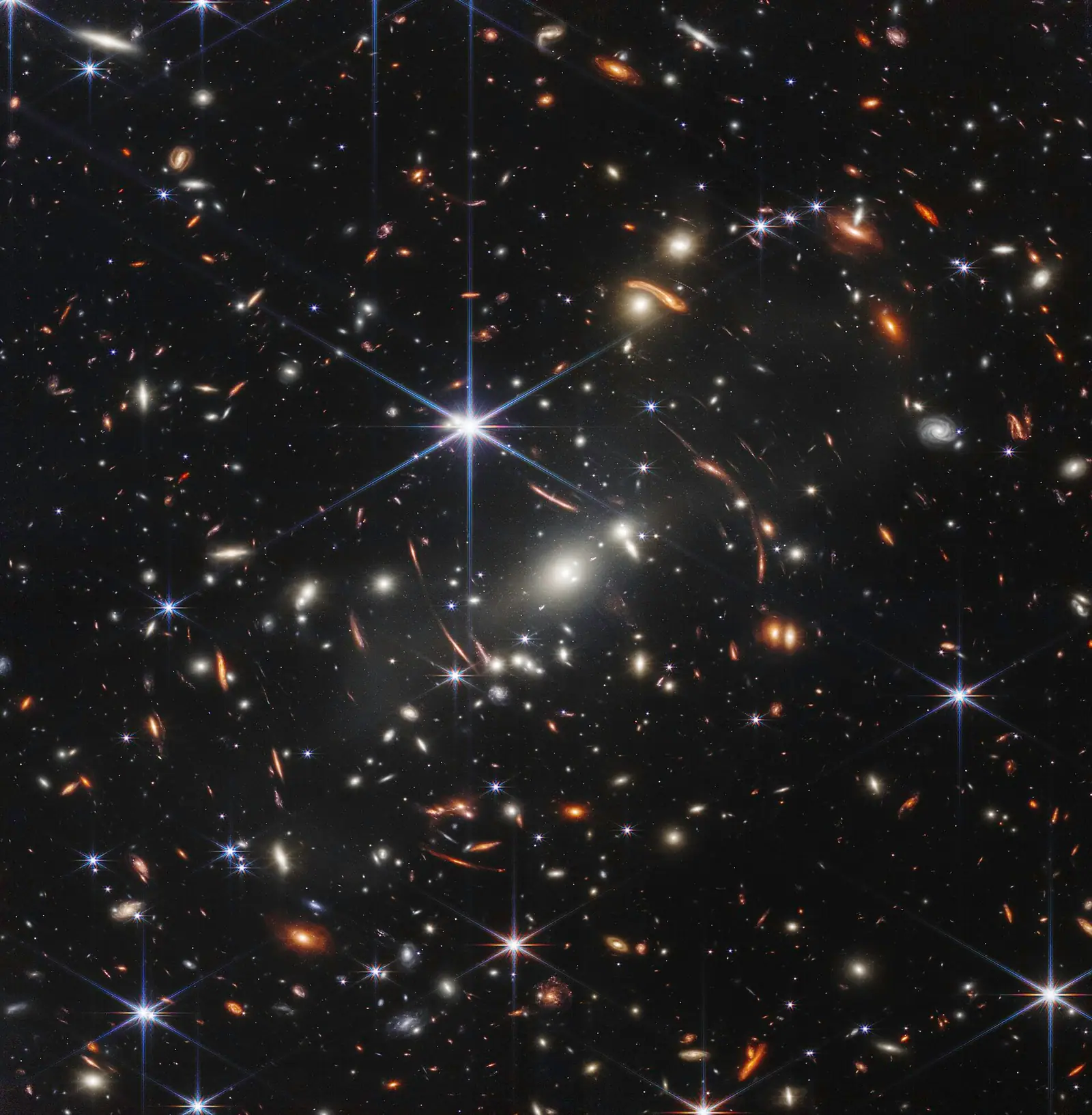
This patch of sky is tiny: the size of a grain of sand held at arm’s length.
The James Webb telescope photographed thousands of galaxies in it. Each one contains billions of stars.
NASA, ESA, CSA et STScI · Public domainThe iron in your blood, the calcium in your bones, the oxygen you breathe were made in the hearts of stars that died before the Sun was born. Their explosions scattered them through space, where they eventually formed the Earth… and you.
The hydrogen in your body dates from the very first minutes of the universe. You are 13.8 billion years old.
7 billion billion billion atoms in your body, roughly
Almost all of them have already been used elsewhere: in other stars, other rocks, other living things.
The universe doesn’t just shine: it vibrates. On September 14, 2015, two giant detectors in the United States picked up a gravitational wave for the first time, a vibration of space itself.
It was sent out by two black holes that merged 1.3 billion years ago. As it passed, it stretched and then squeezed the detectors’ 2.5-mile (4-kilometer) arms by about a thousandth of the size of a proton.
Listen
The song of the black holes
Turned into sound, the signal makes a brief rising glissando: a “chirp.” Listen to it.
A sound reconstruction of the gravitational wave GW150914: a low note that rises faster and faster for a few tenths of a second, then cuts out all at once, when the two black holes merge.
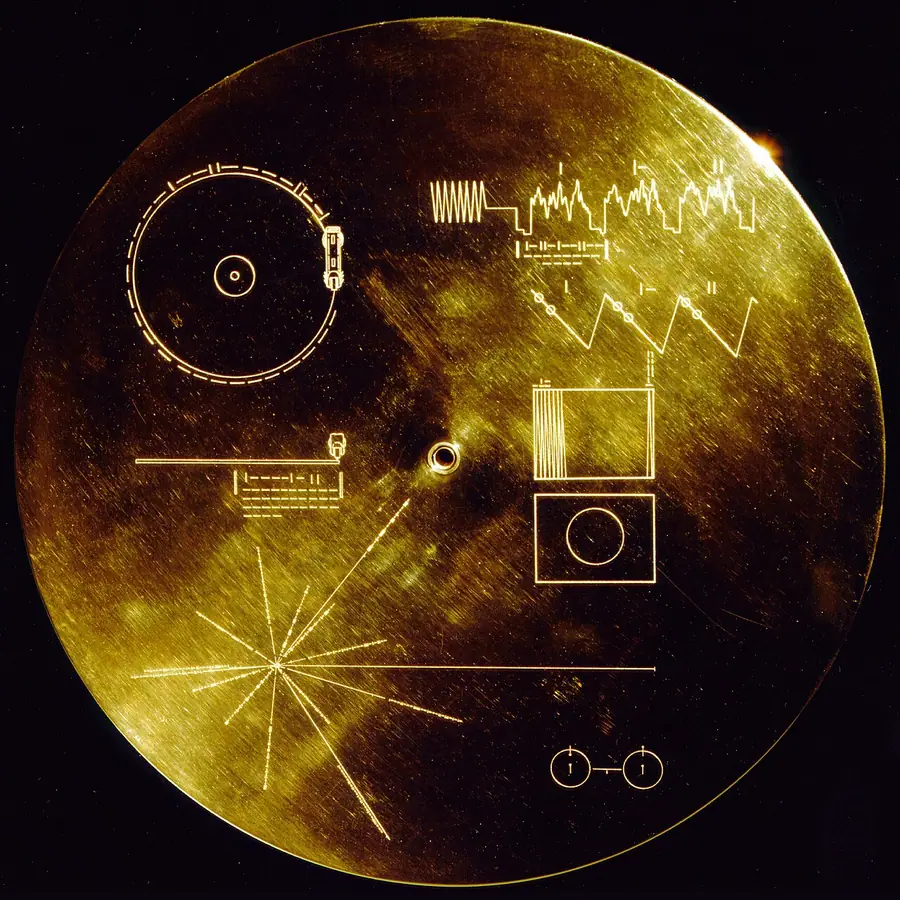
In 1977, the two Voyager probes carried a gold-plated record toward the stars: greetings in 55 languages, sounds of Earth (wind, rain, a kiss, whale songs) and an hour and a half of music, from Bach to Chuck Berry.
NASA/JPL · Public domain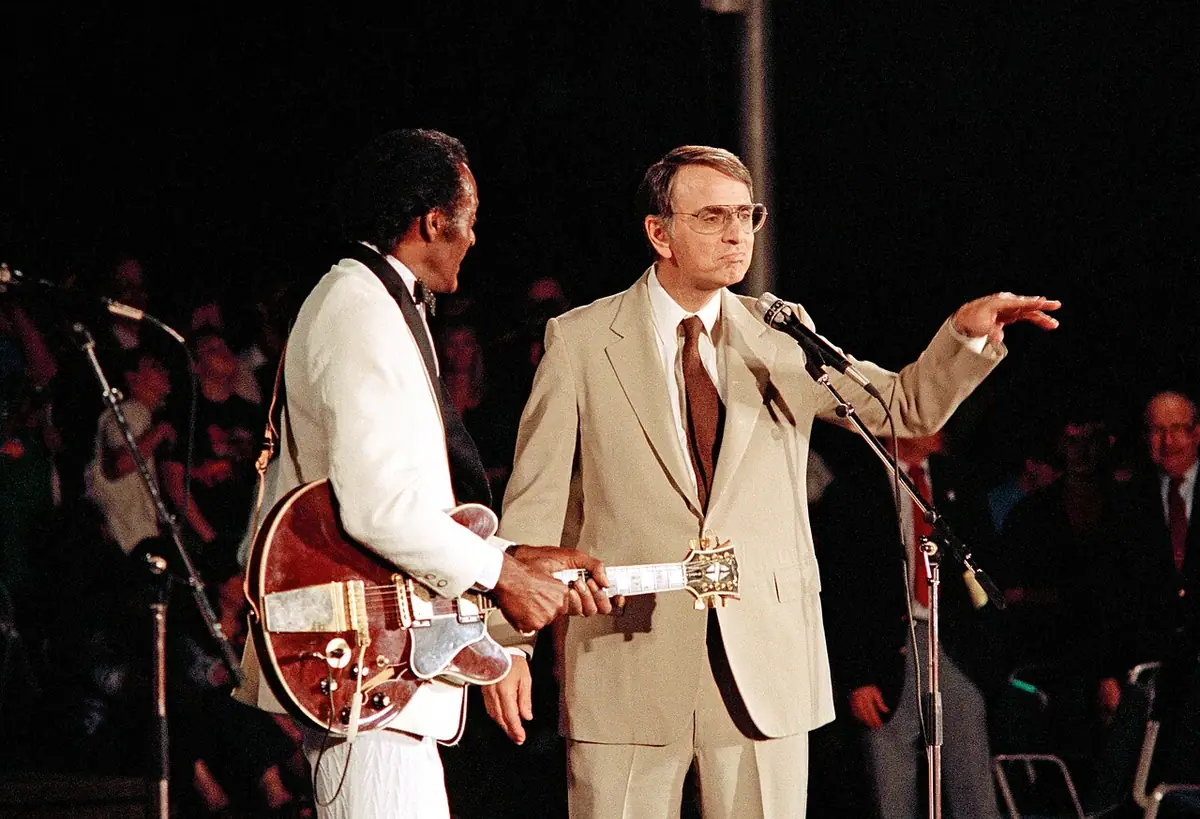
The following year, an American comedy show imagined the aliens’ first reply: “Send more Chuck Berry.”
In August 1989, as Voyager 2 flew past Neptune, Chuck Berry came to play at NASA. Next to him: Carl Sagan.
NASA/JPL · Public domainWhile the record was being prepared, its creative director, Ann Druyan, and Carl Sagan fell in love. For the record, Ann Druyan had an hour of her brain waves and heartbeats recorded, while she thought about the Earth, about human history… and about what it is like to fall in love.
Traveling between the stars is the recording of a heart in love.
Voyager 1 left the Sun’s bubble in 2012. The record should outlast it by hundreds of millions of years.
December 24, 1968. For the first time, human beings are circling the Moon. The three Apollo 8 astronauts photograph its craters, to prepare for future landings.
The Earth is not scheduled.
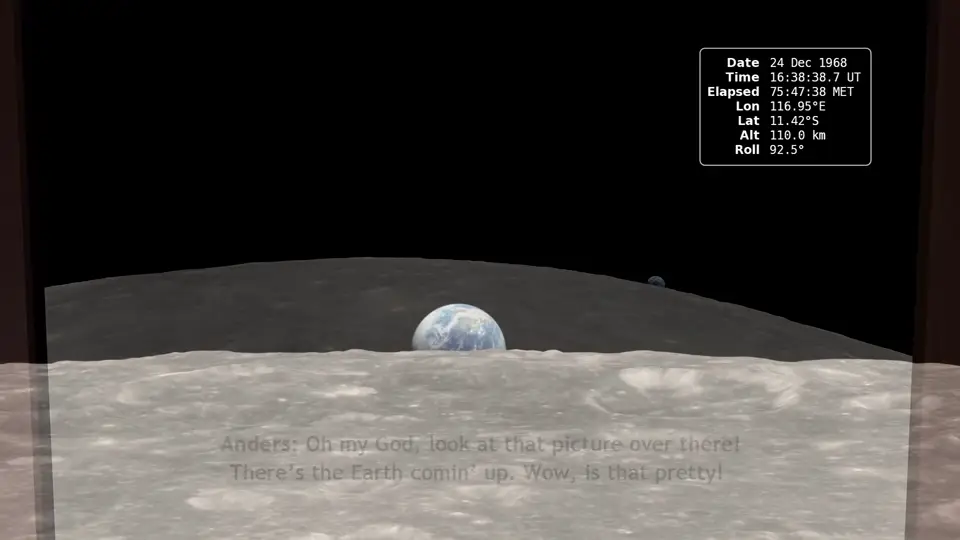
Dialogue
Anders: Oh my God! Look at that picture over there!
Anders: Here’s the Earth coming up. Wow, is that pretty!
Borman: Hey, don’t take that, it’s not scheduled.
Anders: You got a color film, Jim?
Anders: Hand me that roll of color, quick!
Lovell: Oh man, that’s great! Where is it?
Anders: Hurry. Quick.
Lovell: Down here?
Anders: Just grab me a color. A color exterior. Hurry up.
Anders: Got one?
Lovell: Yeah, I’m looking for one… C 368.
Anders: Anything. Quick.
Lovell: Here.
Anders: Well… I think we missed it.
Lovell: Hey, I got it right here, in the hatch window!
Anders: Let me get it out this one, it’s a lot clearer.
Lovell: Bill, I got it framed, it’s very clear right here!
Lovell: You got it? — Anders: Yep.
Lovell: Take several of them! Take several of them!
Lovell: Here, give it to me.
Anders: Wait a minute, just let me get the right setting. Just calm down.
Anders: Calm down, Lovell!
Lovell: Well, I got it… Aw, that’s a beautiful shot.
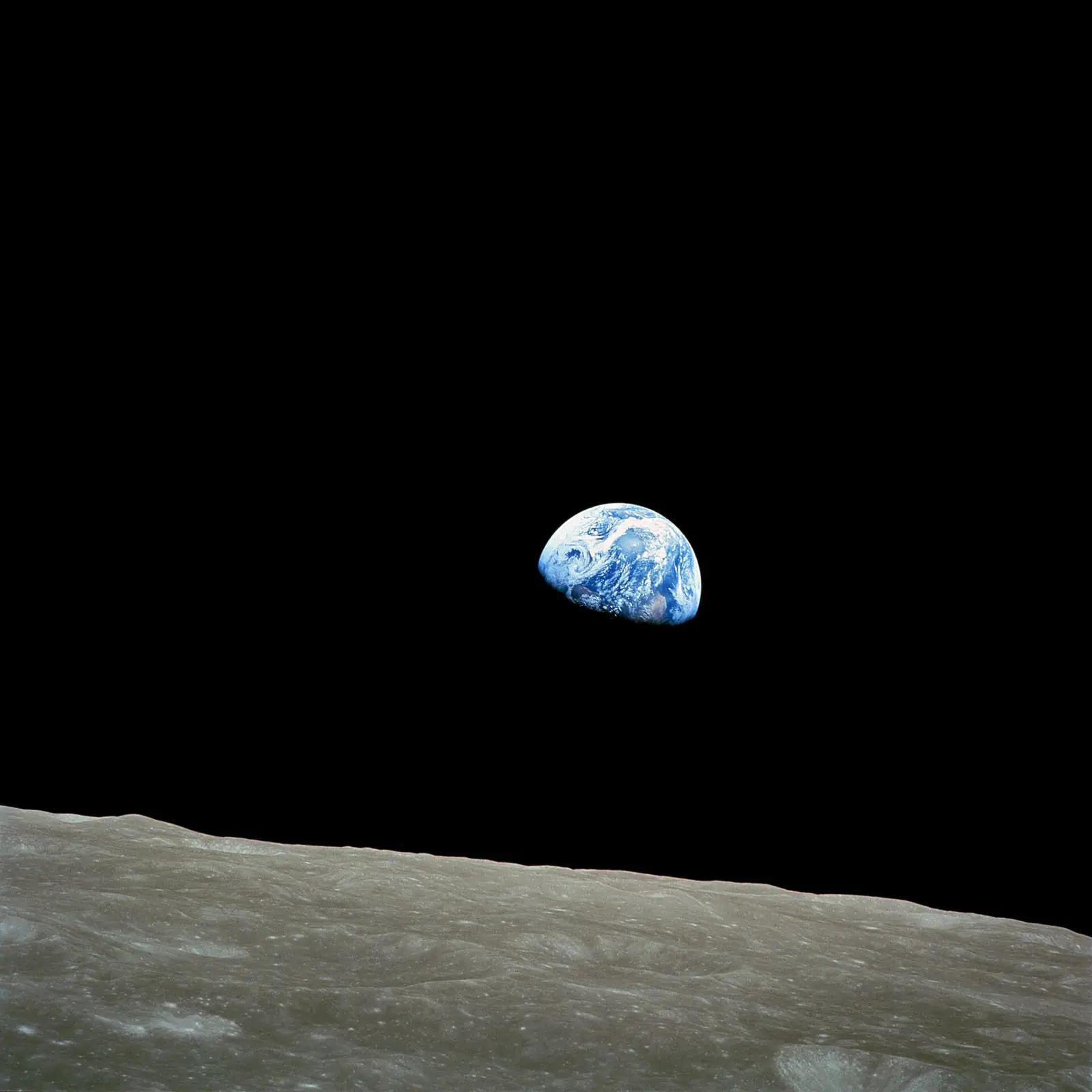
William Anders’s photo. It became one of the most reproduced images in history. Sixteen months later, twenty million Americans took to the streets for the first Earth Day.
NASA/William Anders · Public domain“We came all this way to explore the Moon, and the most important thing is that we discovered the Earth.”
Many astronauts describe the same upheaval when they see the Earth from far away: the absence of borders, the thinness of the atmosphere, a dizzying sense of belonging. In 1987, the writer Frank White called it the “overview effect.”
From the pale blue dot to the black holes, our gaze reaches billions of light-years away. And yet there is one place no instrument has ever observed directly. It lies a few inches behind your eyes. It is where you are reading these words from.
Sources
- NASA/JPL-Caltech, Pale Blue Dot, 1990 (reprocessed version, 2020).
- Carl Sagan, Pale Blue Dot: A Vision of the Human Future in Space, 1994.
- Philip and Phylis Morrison, Charles and Ray Eames, Powers of Ten, 1977.
- LIGO Scientific Collaboration and Virgo Collaboration, “Observation of gravitational waves from a binary black hole merger,” Physical Review Letters, 2016.
- Carl Sagan et al., Murmurs of Earth: The Voyager Interstellar Record, 1978.
- NASA, Apollo 8 mission transcript, 1968; Frank White, The Overview Effect, 1987.