Full transcript of the episode (it gives away every surprise)
Interactive experiment
Ten dollars to share
A stranger has been given $10. He has to offer you part of it. If you accept, each of you keeps your share. If you refuse, nobody gets anything. Five offers, from five different strangers.
Five offers in a row ($5, $3, $1, $2 and $4 out of $10): the reader accepts or refuses each one.
A dollar is better than nothing… really?
You reasoned like the textbooks’ “homo economicus.” You are rare: all over the world, offers of less than 20% are turned down about half the time.
The Christmas Truce
Why do we cooperate when betrayal would pay more? The answer fits in four lines of code… and one night in 1914.
Turning down money to punish a stranger you will never see again: absurd for an economist, human for everyone else. We have a sense of fairness, and it is willing to pay a high price.
Not everywhere in the same way: among the Machiguenga of the Peruvian Amazon, offers are low and almost always accepted; among the Lamalera of Indonesia, who hunt whales as a team and share everything, people often offer more than half.
Here is the most famous game in the social sciences: the prisoner’s dilemma. Two players choose in secret: cooperate or defect.
If both cooperate: 3 points each. If both defect: 1 point each. If one defects and the other cooperates: 5 points for the defector, 0 for the victim.
Interactive experiment
Cooperate or defect
Three opponents, five rounds each. You don’t know who they are. Your move.
The reader plays five rounds against three programmed opponents: one cooperates first and then copies the reader (“tit for tat”), another always defects, and the last one cooperates until the first betrayal, then never forgives.
Against a stranger, defecting always pays. Unless you meet again.
If you only play once, defecting earns more, whatever the other player does. But when the game repeats, everything changes.
In 1980, the political scientist Robert Axelrod organized a tournament. Researchers from all over the world sent in programs, which played the dilemma against each other in matches of two hundred rounds. Devious strategies, calculations, traps… The winner was the shortest of them all: four lines of code.
Anatol Rapoport called it Tit for Tat: cooperate on the first move, then do whatever the other player did on the previous move. A second tournament, with sixty-two entrants, crowned it again.
Interactive experiment
The survival of strategies
A population of strategies plays against itself. In each generation, the richest multiply and the poorest die out. Set the starting population, add errors, and watch who survives.
A simulation evolves a population of strategies (nice, nasty, tit for tat, grudger, random). Depending on the settings, nice but responsive strategies, such as tit for tat, often end up winning.
Axelrod’s lessons fit in four words. Be nice: never be the first to defect. Retaliate: don’t let a betrayal slide. Forgive: return quickly to cooperation. Be clear: make yourself understood.
And above all: cooperation needs neither love nor trust. It needs a tomorrow. As long as you have to meet again, betrayal costs too much.
Axelrod found the most striking example of this logic in the least likely place of all: the trenches of World War I.
Facing each other for months, the same enemy units silently invented a system the soldiers called “live and let live”: you fire, but you miss; you shell at set times, to give the other side time to take cover; you spare the men bringing up the soup.
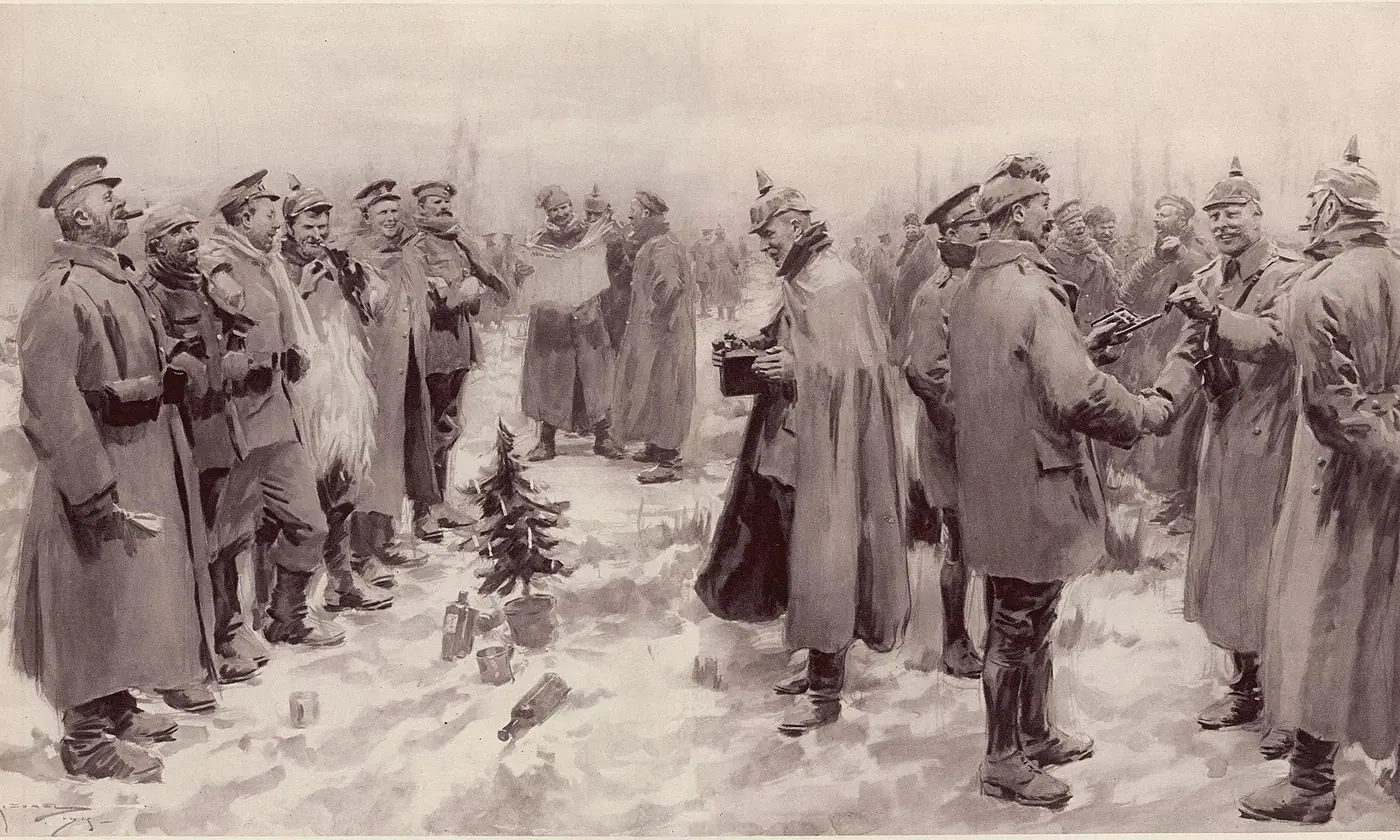
On December 24, 1914, along several stretches of the front, especially in Flanders, German soldiers set candles and little Christmas trees on the parapets, and sing. Opposite them, the British sing back.
Auteur inconnu · Public domainThe next day, men climb out of the trenches, unarmed. They shake hands in no man’s land, swap tobacco, buttons, family photos. They bury their dead together. In places, they play soccer.
The furious high commands ban all fraternization. The war resumes. It will last nearly four more years.
Cooperation doesn’t need love. It needs a tomorrow.
Nature knows this bargain too. Vampire bats die if they go two or three nights without feeding. Those that have eaten well regurgitate blood to feed the hungry ones… preferably those that fed them before.
Reciprocity. Returning the favor, for good or for ill. It is the oldest glue of societies, long before law and money.
Two soldiers can cooperate if they know they’ll meet again. But how do you get millions of strangers who will never meet to cooperate? First, by inventing a tool for talking about what isn’t there. You are using it right now.
Sources
- Werner Güth et al., “An experimental analysis of ultimatum bargaining,” 1982; Colin Camerer, Behavioral Game Theory, 2003.
- Joseph Henrich et al., “In search of Homo economicus: behavioral experiments in 15 small-scale societies,” American Economic Review, 2001.
- Robert Axelrod, The Evolution of Cooperation, 1984.
- Tony Ashworth, Trench Warfare 1914–1918: The Live and Let Live System, 1980; Stanley Weintraub, Silent Night, 2001.
- Gerald Wilkinson, “Reciprocal food sharing in the vampire bat,” Nature, 1984.