Full transcript of the episode (it gives away every surprise)
Question for the reader
A $50 bill. How much is the paper it is printed on worth?
- As much as what’s printed on it
- About $5
- A few cents (correct answer)
If you answer “As much as what’s printed on it”:
Much less: a few cents.
If you answer “A few cents”:
Exactly.
A bill costs only a few cents to make. Its value is not in the paper.
Its value is in your head. And in everyone else’s.
This bill is worth $50 because you are sure the grocer will accept it. And the grocer accepts it because he is sure his supplier will accept it.
The Stone at the Bottom of the Sea
Money is neither gold nor paper. It is a fiction we all believe in at the same time.
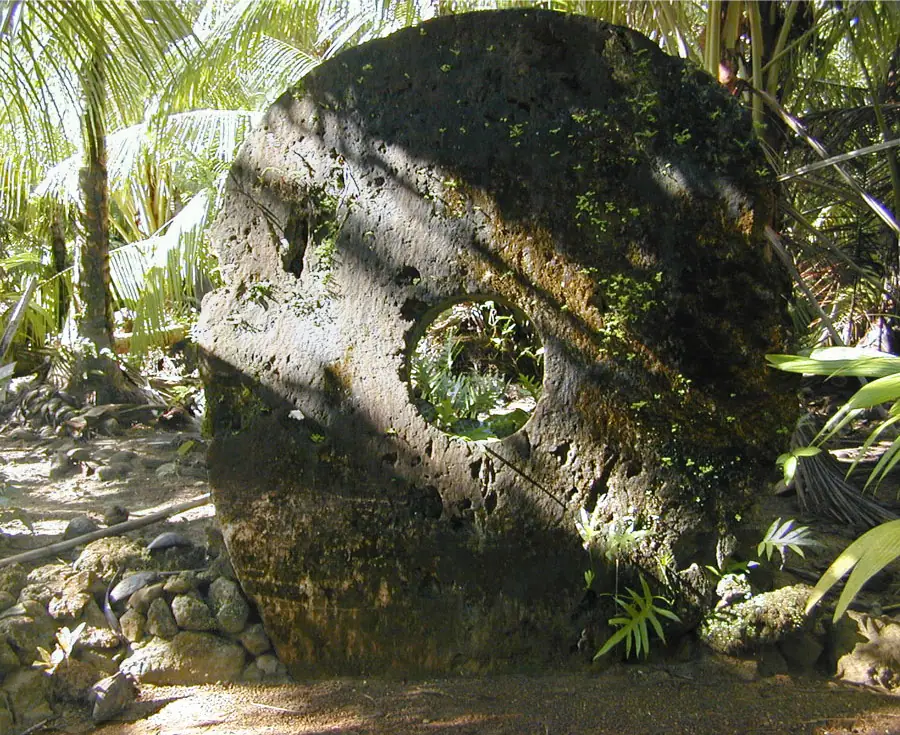
Micronesia, the island of Yap. For centuries, its people used huge stone disks as money, the rai, carved from rock brought back from Palau, 250 miles away. Some are more than ten feet across and weigh several tons.
Eric Guinther · CC BY-SA 3.0When a stone changes hands, nobody moves it. The whole village simply knows that it now belongs to someone else.
It gets better. One day, a gigantic stone, brought back by canoe, sank in a storm not far from the coast. No one ever saw it again. But the crew swore it was magnificent, and the village went on counting it as part of its owner’s fortune.
For generations, then, the richest family on the island was rich… from a stone lying at the bottom of the sea, which nobody had ever seen.
That is exactly your bank account.
You have never seen your money. It is lines in a ledger that everyone has decided to believe in.
Money is neither gold, nor paper, nor stone. It is a shared memory of who owes what to whom, and the confidence that others will accept it tomorrow.
As long as everyone believes in it, it works. And the day everyone doubts at the same time…
Interactive experiment
The rumor
You are one of the twenty customers of a perfectly sound bank. But a rumor is going around. Each day, you decide: leave your money in, or take it out.
The reader plays a customer of a sound bank that keeps only a small share of its deposits in the vault. As the days go by, the rumor grows and other customers withdraw their money; if too many customers show up, the bank can no longer pay.
A sound bank can collapse because everyone believes it is going to collapse.
Banks keep only a small share of deposits in the vault: the rest is lent out. If all the customers come on the same day, the money isn’t there. The fear of bankruptcy causes the bankruptcy.
It is a self-fulfilling prophecy. To stop it, governments now guarantee deposits: in the United States, up to $250,000 per depositor and per bank; in the European Union, €100,000. The guarantee is almost never used… precisely because everyone knows it exists.
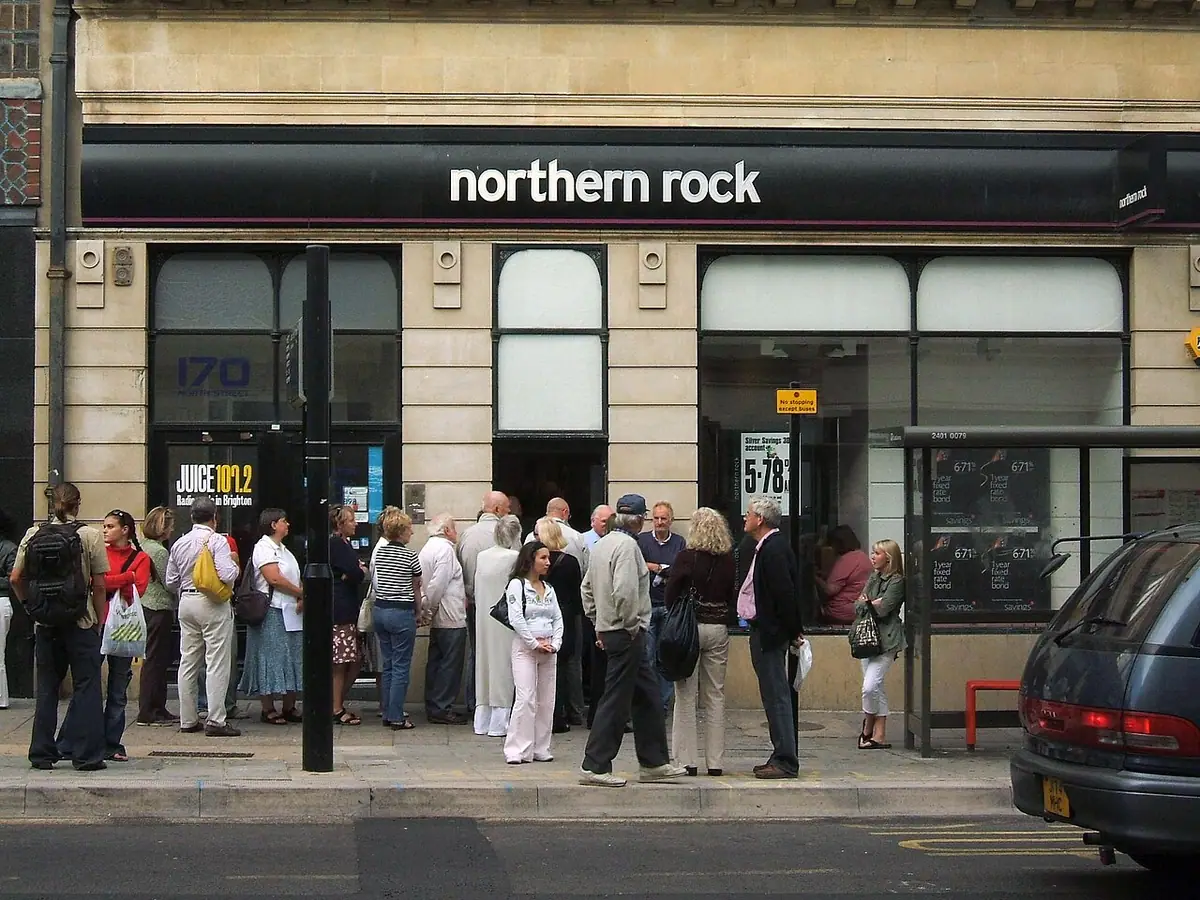
September 2007: in Britain, lines form outside the branches of the Northern Rock bank. It is the country’s first bank run in more than a century.
Dominic Alves · CC BY 2.0March 2023, California: customers of Silicon Valley Bank withdraw $42 billion in a single day, from their phones. The bank closes the next day. Rumors now travel at the speed of the internet.
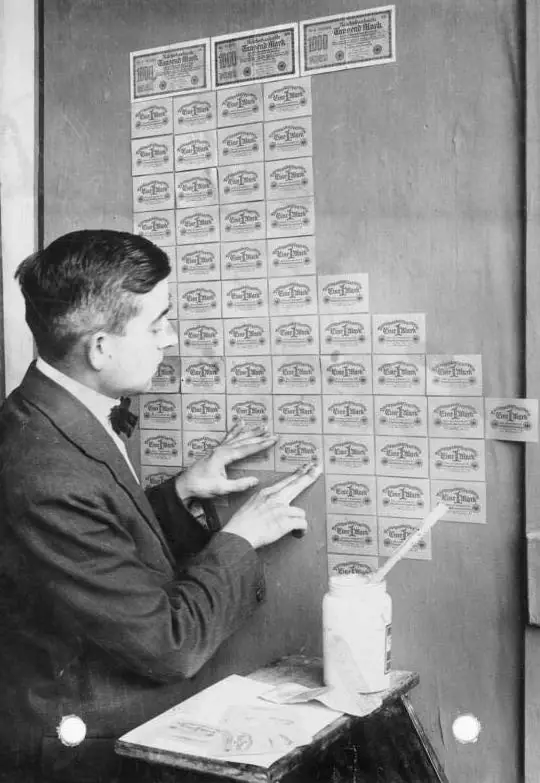
Germany, 1923. Confidence in the mark collapses: prices double every three or four days. In November, a loaf of bread costs hundreds of billions of marks. Banknotes are used as wallpaper: they are cheaper.
Georg Pahl (Bundesarchiv) · CC BY-SA 3.0 deWorkers are paid twice a day, and run to spend their wages before they melt away. A lifetime of savings is no longer enough to buy a stamp.
A hundred years later, the fear of inflation is still part of German memory.
Question for the reader
You are given two glasses of the same wine to taste. You are told that one costs $10 and the other $90. Which do you prefer?
- The $90 one
- The $10 one
- No difference
In 2008, researchers ran this experiment inside a brain scanner. The volunteers preferred the wine presented as expensive, and a region of their brain linked to pleasure lit up more. Price doesn’t only change your judgment: it changes the pleasure itself.
May 22, 2010: a Florida programmer, Laszlo Hanyecz, pays 10,000 bitcoins for two pizzas. It is one of the very first purchases made with this digital currency, which is then worth almost nothing. At its peak, that sum was worth more than a billion dollars.
There is nothing material about bitcoin: it is a ledger, copied onto thousands of computers. A digital Yap stone.
Shared fiction. A reality that exists only because many people believe in it together: money, nations, laws, companies. It isn’t false: it is collective.
A confession: a few years ago, this site was born, in French, to talk about saving, budgeting and compound interest. We ended up finding the question even more fascinating than the answer: not “how should I invest my money?” but “why do we all believe in it?”
Money holds up as long as we give it our trust. But another resource has become more precious still, and thousands of engineers work every day to take it from you. You are spending it right now.
Sources
- William Henry Furness III, The Island of Stone Money, 1910; Milton Friedman, “The Island of Stone Money,” 1991.
- Douglas Diamond and Philip Dybvig, “Bank runs, deposit insurance, and liquidity,” Journal of Political Economy, 1983.
- Bank of England, reports on Northern Rock, 2007–2008; FDIC, report on the failure of Silicon Valley Bank, 2023.
- Adam Fergusson, When Money Dies: The Nightmare of the Weimar Hyperinflation, 1975.
- Hilke Plassmann et al., “Marketing actions can modulate neural representations of experienced pleasantness,” PNAS, 2008.
- Yuval Noah Harari, Sapiens, 2014 (on shared fictions).