Full transcript of the episode (it gives away every surprise)
Interactive experiment
Three shapes
A short animation, with no sound or text. Watch it to the end.
A large triangle, a small triangle and a small circle move around a rectangle, one side of which opens like a door. The large triangle seems to chase the other two, who end up escaping together. The reader is then asked what they saw.
There were only three shapes and a rectangle.
And you saw a story in it, with a bully, fugitives, a door. Your brain couldn’t help it.
In 1944, the psychologists Fritz Heider and Marianne Simmel showed a similar film to students. Almost all of them told a story: a bully, a couple, a door, an escape. Only one described geometric shapes.
Once Upon a Time
Your brain can’t help seeing stories. Even where there are none.
We are a storytelling species. Faced with movement, your brain looks for an intention; faced with intentions, it weaves a story.
According to one hypothesis, our ancestors who saw intentions everywhere survived better: better to mistake a rustle for a predator than the other way around.
When someone tells you a story, your brain does something strange: it synchronizes with the storyteller’s. In 2010, at Princeton, Uri Hasson’s team measured it. The stronger the synchronization, the better the listener understands.
The novelist Kurt Vonnegut argued that stories have shapes you can draw: the hero’s fortunes over the course of the story. His university rejected the thesis, he said, “because it was so simple and looked like too much fun.”
Interactive experiment
The shape of stories
In 2016, researchers analyzed more than 1,300 stories and found six great shapes in them. Your turn: what shape does each of these stories have?
Six curves of “the hero’s fortune” are offered: rags to riches, riches to rags, man in a hole (fall then rise), Icarus (rise then fall), Cinderella (rise, fall, rise) and Oedipus (fall, rise, fall). The reader matches four famous stories to their shape.
There is another shape you know well: the interrupted story. In the 1920s, in Berlin, the psychologist Bluma Zeigarnik noticed that a waiter effortlessly remembered unpaid orders… and forgot them as soon as they were paid.
Recent studies doubt that we remember unfinished tasks better. But the urge to get back to them, to find out what happens next, has never been disproved.
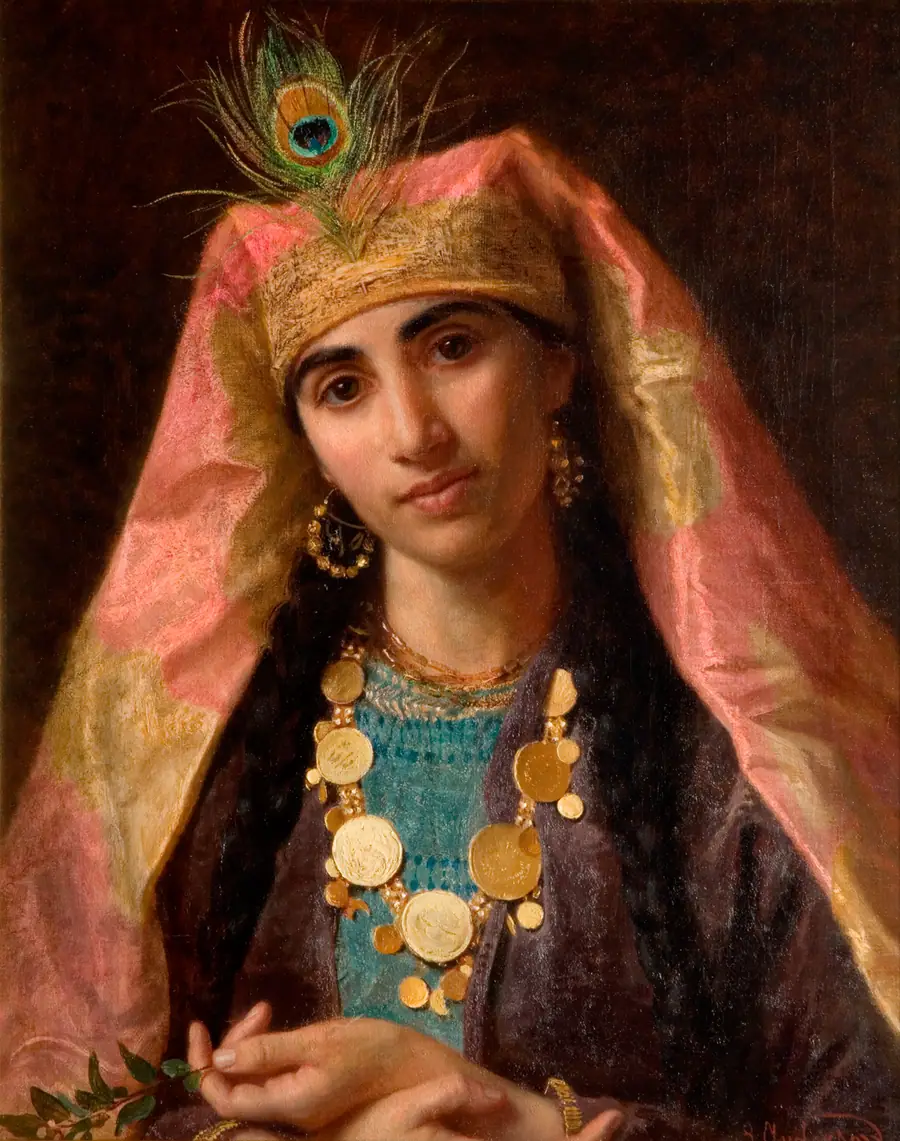
Scheherazade understood this long before. To escape death, every night she breaks off her tale at the crucial moment. The king, who wants to know what happens next, lets her live one more day. A thousand and one nights.
Sophie Gengembre Anderson · Public domainThis adventure is playing the same trick on you.
Every episode ends on a question. You know it. And you still want to know what happens next.
Do all stories need conflict? In the West, we learn that a story pits a hero against an obstacle.
In China, Korea and Japan, a four-part structure, kishōtenketsu, does very well without it: a situation, its development, an unexpected sidestep, then a conclusion that ties everything together.
Nintendo designers build the levels of their games this way: an idea introduced, developed, turned on its head, concluded. You don’t need an enemy to make a story.
“For sale: baby shoes, never worn.”
Six words. An entire tragedy, which you just wrote yourself.
It is attributed to Hemingway. He almost certainly never wrote it.
Versions of this story were circulating in newspapers as early as 1906. No matter: a good story leaves gaps, and you are the one who fills them in.
Question for the reader
Your turn: a story in six words.
Saved in your dossier. Read it again in a month: you may read a different story in it.
Why do we cry over characters who don’t exist? Because, for your brain, they exist a little.
The circuits you use to understand other people switch on for Anna Karenina just as they do for a triangle being chased. Some researchers see fiction as a “flight simulator” for social life: a place to practice, risk-free, being someone else.
Theory of mind. The ability to attribute thoughts, desires and intentions to others. It switches on in front of a person, a character in a novel… or three geometric shapes.
Music, film, stories: each art exploits one of our brain’s habits. That leaves the oldest one, the painters’ habit. Your brain invents colors.
Sources
- Fritz Heider and Marianne Simmel, “An experimental study of apparent behavior,” American Journal of Psychology, 1944.
- Greg Stephens, Lauren Silbert and Uri Hasson, “Speaker–listener neural coupling underlies successful communication,” PNAS, 2010.
- Andrew Reagan et al., “The emotional arcs of stories are dominated by six basic shapes,” EPJ Data Science, 2016.
- Kurt Vonnegut, A Man Without a Country, 2005.
- Bluma Zeigarnik, 1927; Rebekka Ghibellini and Beat Meier, “The hypothesis of the Zeigarnik effect revisited,” Humanities and Social Sciences Communications, 2023.
- Koichi Hayashida, interview on the level design of Super Mario 3D Land, 2012.
- Quote Investigator, “For sale, baby shoes, never worn,” 2013.
- Raymond Mar and Keith Oatley, “The function of fiction is the abstraction and simulation of social experience,” 2008.