Full transcript of the episode (it gives away every surprise)
Interactive experiment
Strawberries
What color are these strawberries? Answer, then check with the eyedropper.
A photo of strawberries bathed in bluish light: the strawberries look red, but not a single pixel of the image is red. An eyedropper reads the true color of each point: gray.
There is not a single red pixel in this image.
Your brain compensated for the bluish lighting, and gave you back the red it expected.
Red Does Not Exist
Colors are not in the world: your brain makes them, and painters know it.
Light has no color. It has wavelengths.
At the back of your eyes, three kinds of cones respond mostly to short, medium and long waves. Your brain compares their three signals and makes colors out of them. It takes into account the lighting, the surroundings and what it knows about objects.
Magenta exists in no rainbow: no wavelength corresponds to it. It is the color your brain invents when it receives red and blue at the same time, without the green that separates them.
Interactive experiment
Colors that aren’t there
Two experiments. The first requires twenty seconds of stillness.
The reader stares for twenty seconds at a yellow, black and cyan flag, then at a white surface: a blue, white and red flag appears on it. Then two identical gray squares look like different shades depending on the background they sit on.
February 2015: the photo of a dress goes around the world. Blue and black, or white and gold?
The dress was blue and black. But a large minority saw it as white and gold, depending on the lighting their brain assumed. Early risers, used to daylight, tended to see white and gold.
And words? In the Iliad and the Odyssey, Homer never describes the sea as blue: it is “wine-dark.”
In 1858, the future British prime minister William Gladstone counted the colors in Homer. Black comes up about 170 times, white about a hundred, red thirteen, yellow and green fewer than ten times. Blue: never.
The Greeks could see blue, of course. But every language carves up the rainbow in its own way.
Russian has two words for blue: goluboy, the light one, and siniy, the dark one. Measured in 2007: Russian speakers tell apart two blues with different names a little faster.
Interactive experiment
The odd one out
In each grid, one square is a slightly different shade. Find it as fast as you can.
Grids of green, then blue squares: in each one, one square differs very slightly. The reader looks for it, against the clock.
You may have seen a claim going around: a people of Namibia, the Himba, supposedly cannot tell blue from green. It is an exaggeration born of a documentary. The Himba see the difference perfectly well; their language simply sorts colors differently.
Interactive experiment
The smile that slips away
Look at the Mona Lisa’s eyes: she smiles. Look at her mouth: the smile fades. Compare what the center of your gaze sees with what its edges see.
The face of the Mona Lisa is shown sharp, then blurred, as peripheral vision sees it: in the blurred version, the smile is much stronger.
In 2000, the neurobiologist Margaret Livingstone explained it: the Mona Lisa’s smile is made of blurry shadows, which peripheral vision picks up better than central vision. When you look at the mouth, you lose it. Leonardo painted it in the haze that Italians call sfumato.
Claude Monet painted the same Japanese footbridge all his life. In the early 1920s, cataracts clouded his eyes: his colors turned brown and red, and the blues escaped him.
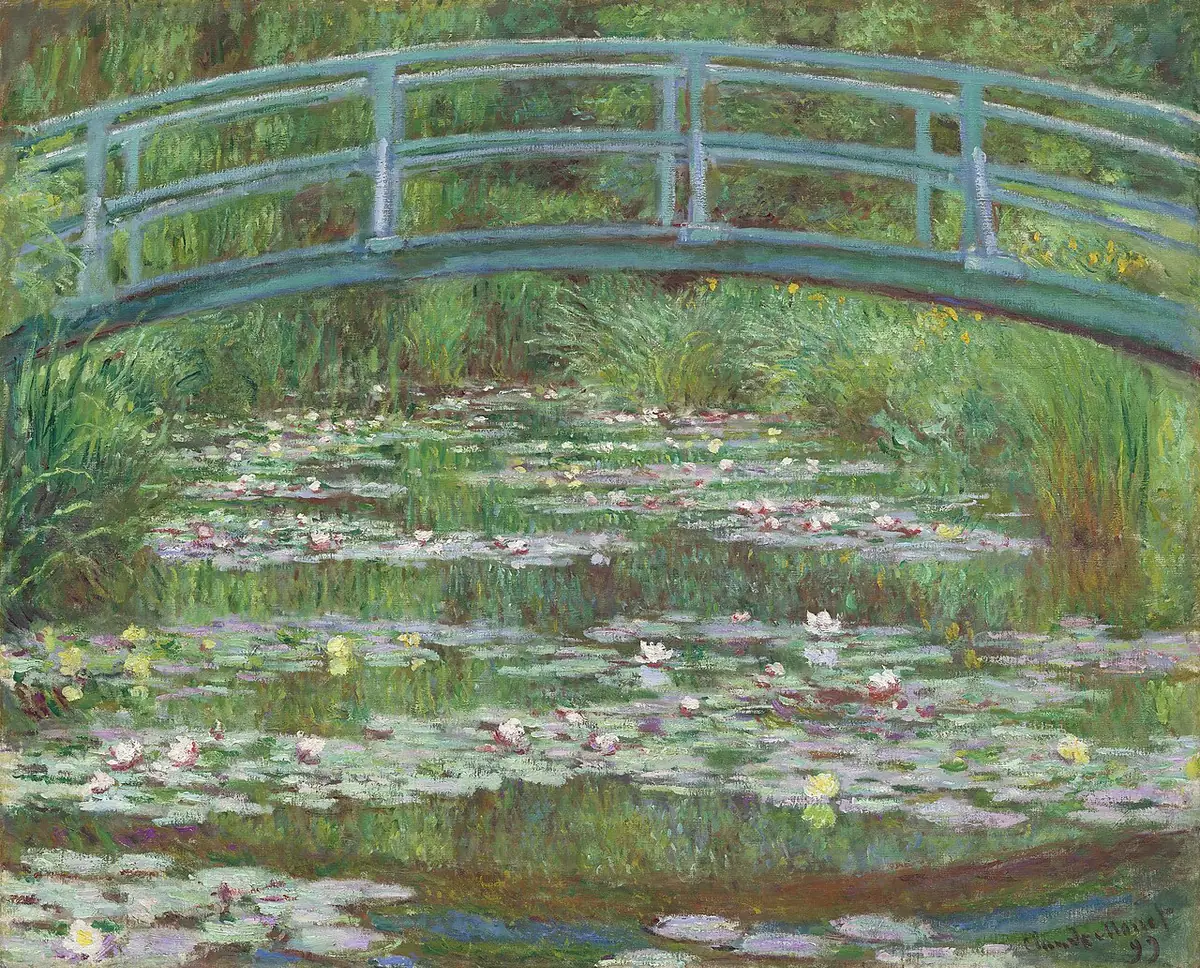
In 1899 Claude Monet · CC0
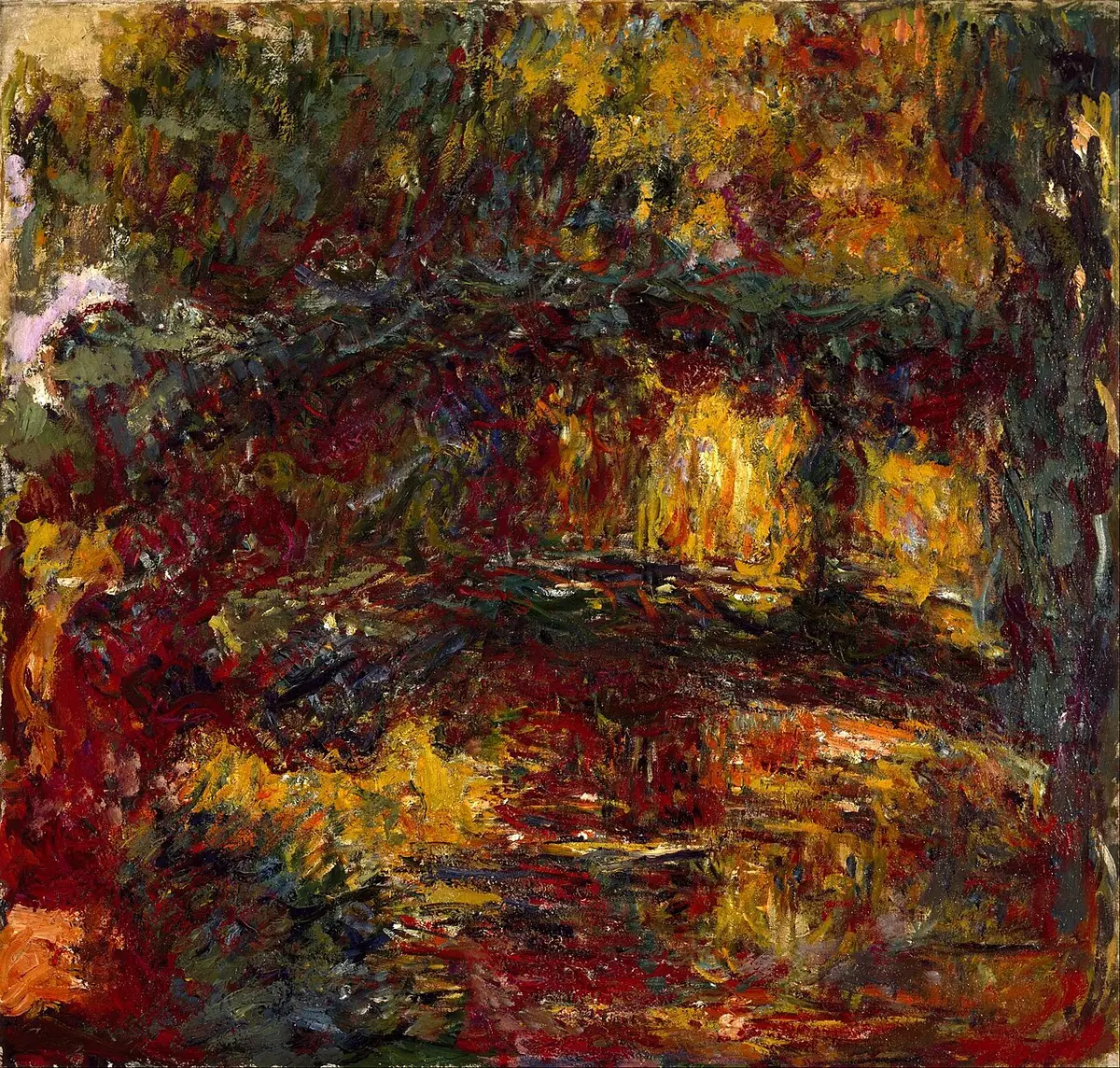
Around 1920–1924 Claude Monet · Public domain
In 1923, he had surgery on one eye. According to an appealing but debated hypothesis, without its lens the eye may have perceived a little ultraviolet: hence the violet blues of his last canvases.
On November 12, 1918, the day after the armistice, an almost blind Monet wrote to his friend Georges Clemenceau: he wanted to give the French state two canvases, to celebrate the peace.
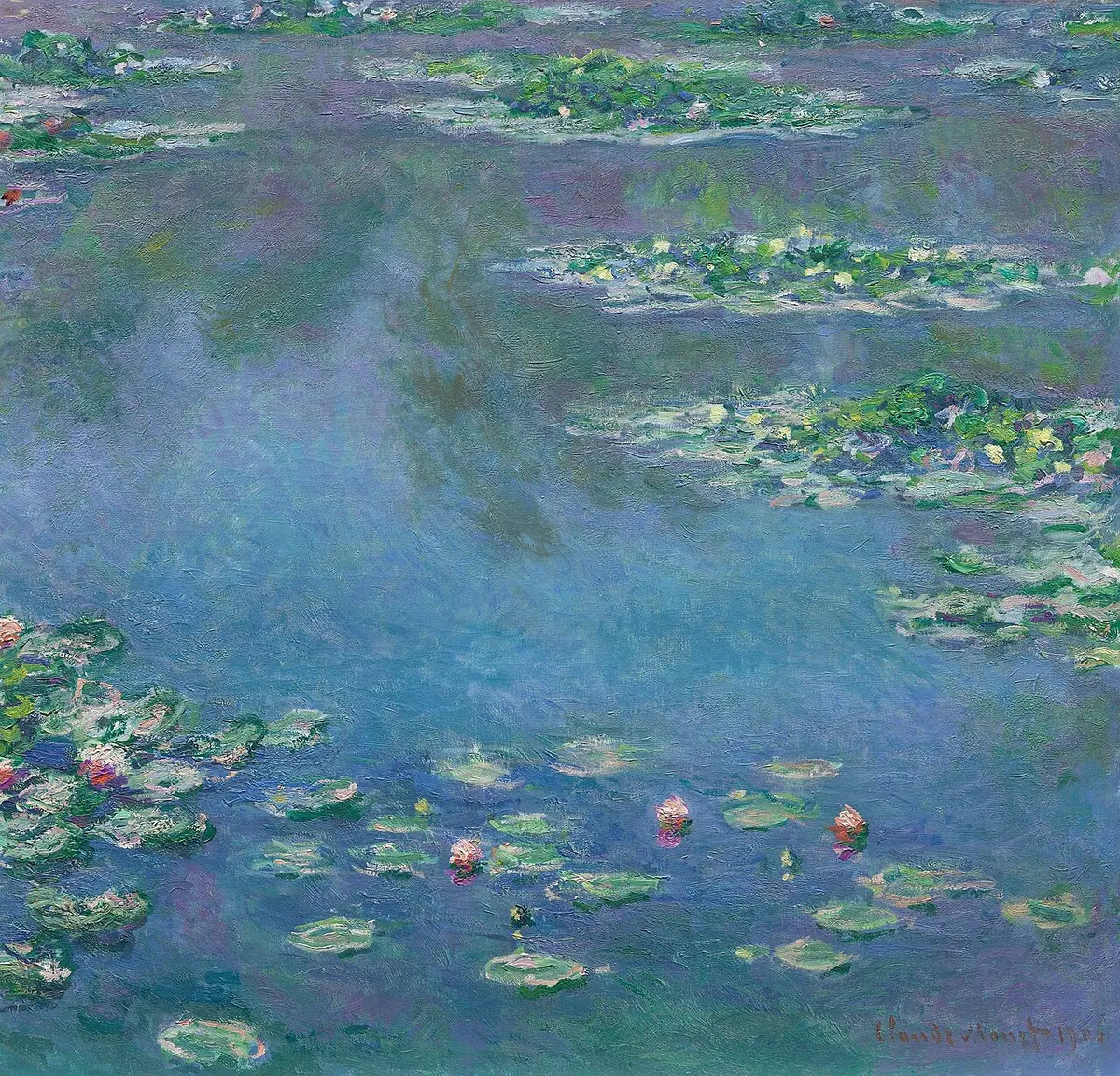
The gift became a cycle: eight immense panels of water lilies, installed at the Orangerie in 1927, a few months after his death. People still walk into them today as into a place of silence.
Interactive experiment
The most beautiful rectangle
Five rectangles. Which one do you find the most harmonious?
Five rectangles with different proportions are offered; one of them follows the golden ratio (1.618). The reader picks the one they prefer.
There is nothing magical about the golden ratio.
It is said to be more beautiful than any other ratio. Experiments find no clear preference: tastes vary, and change from one day to the next. As for the Parthenon or the Mona Lisa being “built on the golden ratio,” you only have to draw the rectangles wherever it suits you.
Sources
- Akiyoshi Kitaoka, color constancy illusions; Bevil Conway, research on color vision.
- Rosa Lafer-Sousa, Katherine Hermann and Bevil Conway, “Striking individual differences in color perception uncovered by ‘the dress’ photograph,” Current Biology, 2015; Pascal Wallisch, Journal of Vision, 2017.
- William Gladstone, Studies on Homer and the Homeric Age, 1858.
- Jonathan Winawer et al., “Russian blues reveal effects of language on color discrimination,” PNAS, 2007.
- Debi Roberson et al., “Color categories: evidence for the cultural relativity hypothesis,” Cognitive Psychology, 2005.
- Margaret Livingstone, “Is it warm? Is it real? Or just low spatial frequency?,” Science, 2000.
- Michael Marmor, “Ophthalmology and art: simulation of Monet’s cataracts and Degas’ retinal disease,” Archives of Ophthalmology, 2006.
- George Markowsky, “Misconceptions about the golden ratio,” College Mathematics Journal, 1992.