Full transcript of the episode (it gives away every surprise)
Question for the reader
1872, California. A question divides horse lovers: at full gallop, does a horse ever have all four hooves off the ground at once?
- Yes (correct answer)
- No, one hoof always stays on the ground
- Impossible to know
If you answer “Yes”:
Yes. But wait until you see how.
If you answer “No, one hoof always stays on the ground”:
The human eye is too slow to settle it. It took a camera.
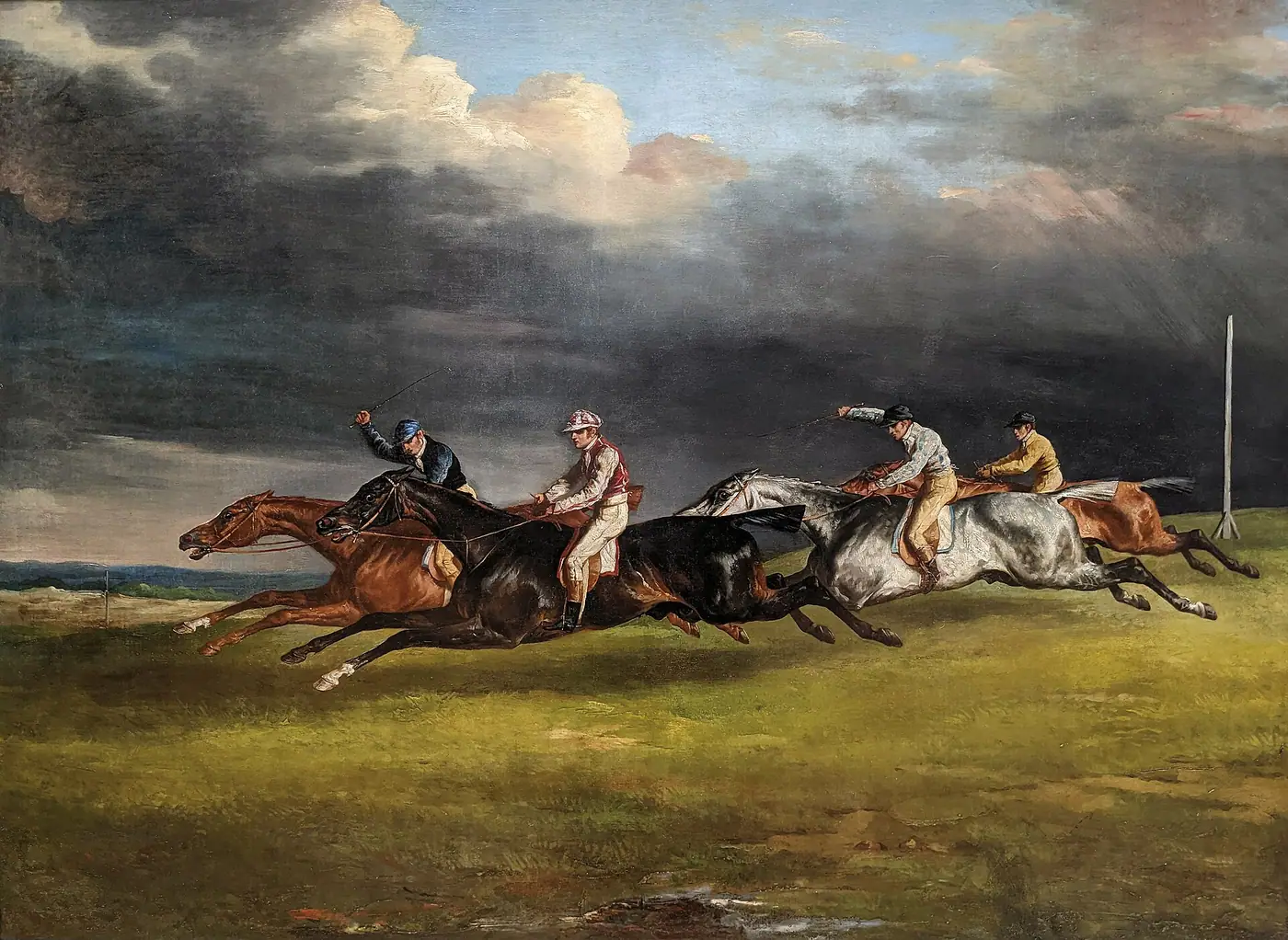
For centuries, painters showed the gallop like this: legs stretched out forward and back, the horse flying above the ground.
Théodore Géricault · Public domainLeland Stanford, former governor of California and railroad tycoon, wanted to know for sure. He hired a moody English photographer: Eadweard Muybridge. Legend has it there was a $25,000 bet; it may never have existed.
On June 19, 1878, in Palo Alto, twelve cameras were lined up along the track, triggered by threads that the mare Sallie Gardner broke as she went by.
Interactive experiment
The eleven photos
Here are the photos, one by one. Find the one where all four hooves have left the ground.
The reader examines Muybridge’s eleven photographs and looks for the one where the horse is off the ground: it’s the second, legs tucked under its belly.
Twenty-Four Lies a Second
Cinema is made of nothing but still images… and your brain.
All four hooves really do leave the ground.
But with the legs tucked under the belly, never stretched out. Géricault, and centuries of painters before him, had painted a movement that does not exist.
Interactive experiment
Faster
Play the eleven photos faster and faster. At what point do you see a running horse, rather than a series of photos?
Muybridge’s photos play at an adjustable rate. At around ten frames per second, the brain stops seeing photos and sees a galloping horse.
That is the whole secret of cinema: still images, shown fast enough for your brain to invent the motion between them.
At the movies, twenty-four per second. A two-hour film: 172,800 photographs.
There is more. In a theater with a film projector, a shutter blocks the screen every time the film advances by one frame.
You spent half the movie in the dark.
Without ever seeing it: your brain glues the frames together, just as it glues together what your eyes see between two saccades.
December 1895, Paris. In the Salon Indien of the Grand Café, on the Boulevard des Capucines, Louis and Auguste Lumière hold the first paid public screenings of their Cinématographe. Among the films of the first weeks…
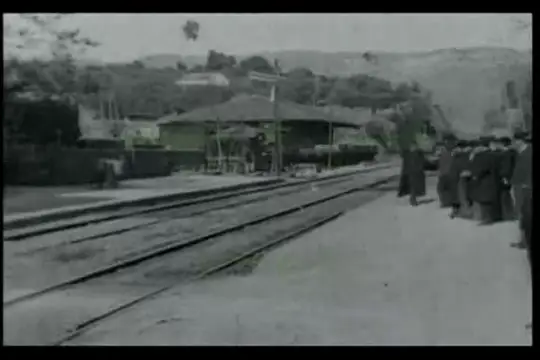
Legend has it that the terrified audience jumped up to flee the locomotive. No account from the time confirms it: the panic is very probably a myth, invented later.
But the myth says something true: at the movies, our body reacts as if what we see were real.
Twenty years later, in Moscow, a filmmaker barely twenty years old, Lev Kuleshov, took the idea further. What interested him was not what an image shows, but what happens between two images.
Interactive experiment
Three edits
Three short edits. After each one, say what the actor is feeling.
An actor’s face is shown three times, preceded by a bowl of soup, a grave covered with flowers, then a child with a teddy bear. Each time, the reader says what the actor is feeling: hunger, grief, tenderness… Yet it is exactly the same shot of the face.
It was the same shot. All three times.
The emotion wasn’t in the face of the actor, Ivan Mozzhukhin. It was between the images: in your head.
Kuleshov’s original film is lost, and recent studies find an effect that is real but more modest than the legend. Film editors, though, use it every day: the meaning of a shot depends on the one before it.
Interactive experiment
A conversation in a café
The same scene, twice. The first time, just watch. The second time, you will know something the characters don’t.
Two men chat in a café. First version: after fifteen seconds, a bomb hidden under the table goes off without warning. Second version: the viewer sees the bomb and its timer from the start; the same dull conversation becomes unbearable.
“In the first case we have given the public fifteen seconds of surprise at the moment of the explosion. In the second case we have provided them with fifteen minutes of suspense.”
The recipe for suspense fits in one sentence: give the audience a piece of information the characters don’t have.
They no longer wonder “what is going to happen?” but “when?” And they suffer, deliciously.
Interactive experiment
Vertigo
1958. To make his hero feel vertigo, and you too, Alfred Hitchcock and his cameraman Irmin Roberts invented an impossible movement: the camera pulls back while the lens zooms in. Try it.
A character stands in a corridor. The reader pulls the camera back while zooming in: the character stays the same size, but the set stretches away behind them. This is the “dolly zoom” of Vertigo, reused in Jaws.
Cinema works on your ears too. For Dunkirk (2017), the composer Hans Zimmer built his score on a sound illusion: a scale that seems to rise without ever stopping. The tension never lets up.
Listen
The endless staircase
The Shepard scale. Listen to it rise… and rise again.
A scale seems to rise forever: each note is made of several octaves stacked together; the high ones fade out while new low ones fade in.
Listen
One film, three scores
A film from 1895, three accompaniments. For each one, say what story you see.
The same Lumière brothers film, a boat heading out of the harbor into the swell, is accompanied in turn by tender music, menacing music and comic music. The reader sees three different stories in it.
Music doesn’t decorate the pictures. It tells you what to feel.
And you obey.
Cinema, finally, is a business for magicians. Georges Méliès ran a magic theater in Paris when he discovered the Cinématographe in 1895. He invented special effects: disappearances, superimpositions, dissolves.
He shot more than five hundred films. And he sent his audiences all the way to the Moon.
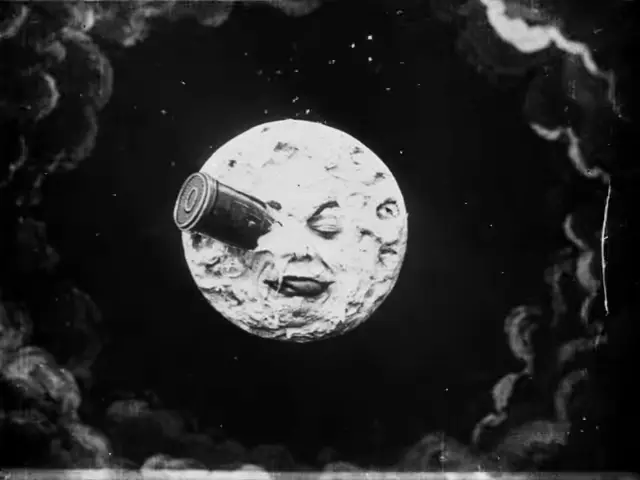
Then audiences lost interest. In 1923, ruined, Méliès burned his own negatives; some of his prints had already been melted down during the war to recover the material.
He was found again in the late 1920s, selling toys and candy at a kiosk in the Montparnasse train station.
In 1993, a copy of A Trip to the Moon, colored by hand frame by frame, was found in Barcelona, in tatters.
It took eighteen years to bring it back to life.
Restored frame by frame, it was screened at the Cannes Film Festival in 2011. Méliès’s dreams outlived Méliès.
Photos that move, faces that change emotion, a bomb that doesn’t go off: cinema exploits a habit we all share. We can’t help seeing stories. Even where there are none.
Sources
- Rebecca Solnit, River of Shadows: Eadweard Muybridge and the Technological Wild West, 2003.
- Martin Loiperdinger, “Lumière’s Arrival of the Train: Cinema’s Founding Myth,” The Moving Image, 2004.
- Daniel Barratt et al., “Does the Kuleshov effect really exist?,” i-Perception, 2016.
- François Truffaut, Hitchcock/Truffaut, 1966.
- Hans Zimmer and Christopher Nolan, interviews on the music of Dunkirk, 2017.
- Madeleine Malthête-Méliès, Méliès l’enchanteur, 1973; Lobster Films, color restoration of A Trip to the Moon, 2011.