Full transcript of the episode (it gives away every surprise)
Try it yourself
- Cross the index and middle fingers of one hand, tightly, as if to wish someone luck.
- Close your eyes.
- Gently rub the tip of your nose, up and down, in the notch formed by your two crossed fingers.
What do you feel?
- Two noses!
- Something strange
- Just one nose
You have just performed the Aristotle illusion. It is 2,300 years old.
Your body is a hypothesis too.
The outer sides of those two fingers never touch. When an object touches both at once, your brain concludes, very logically, that there are two objects.
The Ghost in the Mirror
Your face, your body, your “self”: models your brain builds.
Aristotle already marveled at it: with crossed fingers, touch says “two” when the eyes say “one.” Which to believe? For your brain, that question comes up every moment.
Interactive experiment
An upside-down face
Here is the Mona Lisa, upside down. Take a good look. Nothing unusual? Then turn her over.
The Mona Lisa is shown upside down; her eyes and mouth have been flipped. Upside down, the face looks almost normal. Turned right side up, it becomes monstrous: this is the Thatcher illusion.
Upside down, your brain reads a face as a list of parts: two eyes, a nose, a mouth, all present. Right side up, it reads the face in one go, as a whole, and the slightest anomaly jumps out.
The illusion is named after a prime minister: the psychologist Peter Thompson discovered it in 1980, with a photograph of Margaret Thatcher.
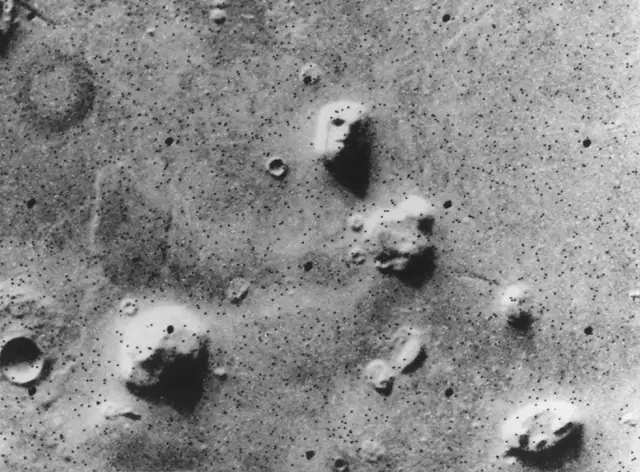
July 25, 1976. The Viking 1 probe photographs the Cydonia region of Mars. On the image appears a face more than a mile long, staring at the sky.
Viking 1, NASA · Public domainQuestion for the reader
What do you think it is?
- A giant sculpture
- A hill (correct answer)
- A flaw in the photo
If you answer “A giant sculpture”:
Let’s take a closer look.
If you answer “A hill”:
Yes: a hill.
For twenty-five years, books and TV shows saw it as proof of a vanished Martian civilization.
In 2001, a far more precise camera photographed the same hill.
Viking 1, 1976 Viking 1, NASA · Public domain
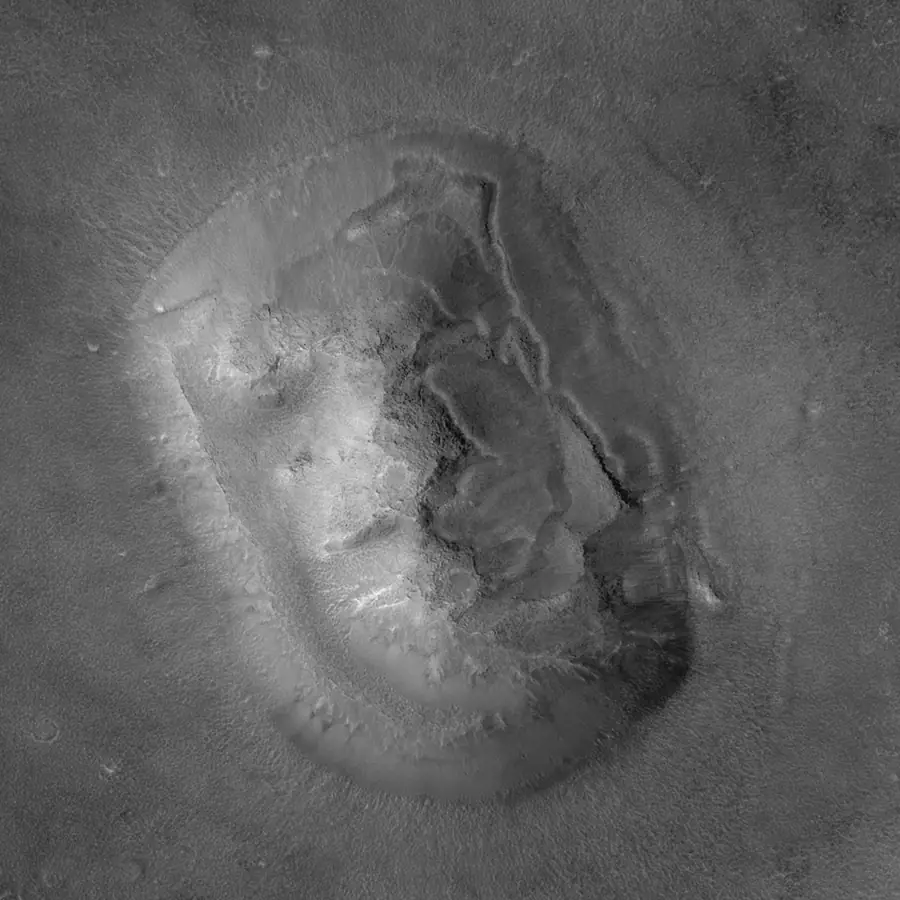
Mars Global Surveyor, 2001 NASA / JPL / Malin Space Science Systems · Public domain
Your brain looks for faces everywhere: in electrical outlets, building fronts, clouds, slices of toast. This is called pareidolia.
A specialized region of your brain responds to a face in less than a fifth of a second. Better to see a face where there isn’t one than to miss the one that is watching you.
In some people, this system doesn’t work well. The neurologist and writer Oliver Sacks could not recognize faces, not even his own.
More than once, he apologized to a large bearded man he had almost bumped into. It was himself, in a mirror.
Faces, fine. But your body? Surely you know where it begins and where it ends.
In 1998, two researchers in Pittsburgh placed a rubber hand on a table in front of a volunteer whose real hand was hidden behind a screen. With two paintbrushes, they stroked both hands at exactly the same time.
After a minute or two, most volunteers felt the brush… on the rubber hand. When it was threatened, their skin began to sweat.
Try it yourself
- Lay one hand flat on a table, hidden behind a book standing on end.
- In front of you, in plain view, place an oven mitt stuffed with rags, in the same position as your hand.
- Ask someone to stroke your real hand and the mitt at the same time, with two paintbrushes, in the same places, for two minutes.
- Look only at the mitt. Then have your partner hit it sharply.
- I’ll try it
- I’ve already done it
- No, thanks
If the illusion takes hold, don’t be surprised if you flinch: your brain will already have adopted the mitt.
The brain’s map of the body can even outlive the body.
After an amputation, almost all patients still feel the missing limb, and many feel pain in it: a fist clenching, fingernails digging into a palm that no longer exists.
In the early 1990s, the neurologist Vilayanur Ramachandran had a disarmingly simple idea: a cardboard box with a mirror in the middle. The patient slides his healthy arm in on one side; in the mirror, its reflection takes the place of the lost arm.
He opens his hand. And, for the first time in years, he feels his phantom fist unclench.
A mirror relieved a pain that nothing else could reach.
The brain believes what it sees. For once, that was used to heal it.
Body schema. The map the brain makes of the body. It updates it constantly; the map can take in a tool or a rubber hand, or keep the trace of an arm that is gone.
In four episodes, your brain has…
invented, erased, rewritten and justified, without ever warning you. Even when you saw through its traps, it had to fight against itself.
Your brain is an illusionist.
And you are its favorite audience.
Sources
- Aristotle, Metaphysics, Book Γ; On Dreams.
- Peter Thompson, “Margaret Thatcher: a new illusion,” Perception, 1980.
- NASA/JPL, images of Cydonia from Viking 1 (1976) and Mars Global Surveyor (2001).
- Nancy Kanwisher et al., “The fusiform face area,” Journal of Neuroscience, 1997.
- Oliver Sacks, The Mind’s Eye, 2010 (chapter “Face-Blind”).
- Matthew Botvinick and Jonathan Cohen, “Rubber hands ‘feel’ touch that eyes see,” Nature, 1998.
- Vilayanur Ramachandran and Diane Rogers-Ramachandran, “Synaesthesia in phantom limbs induced with mirrors,” Proceedings of the Royal Society B, 1996.